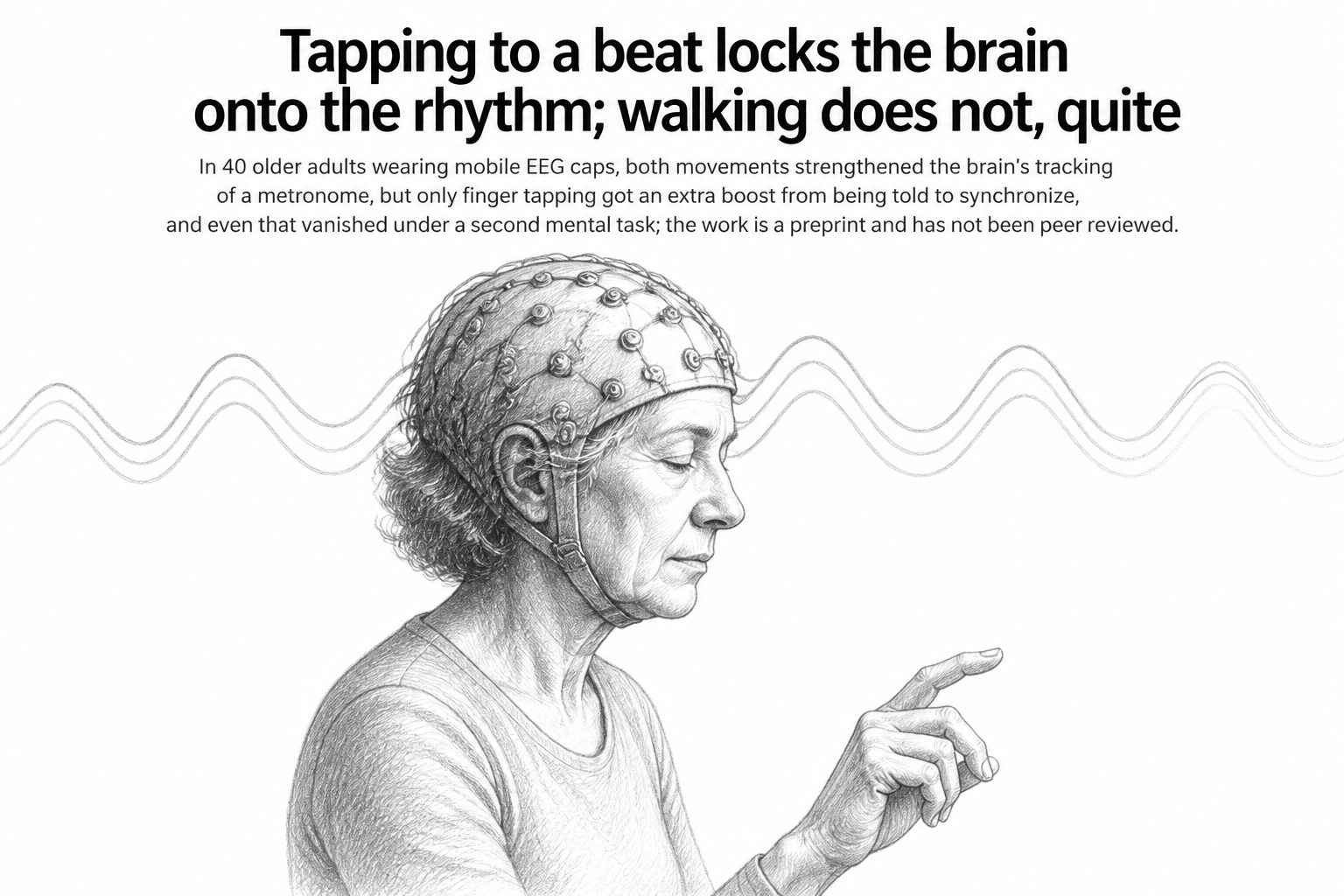
Forty older adults put on mobile EEG caps, listened to a metronome, and did something most of us do without a second thought: they walked. Then they sat and tapped a finger to the same beat. Clara Ziane, Daniele Schön and Simone Dalla Bella of the University of Montreal and Aix-Marseille Université wanted to know whether the brain treats those two acts the same way. It does not.
The starting point is a well-worn observation in neuroscience: when a steady sound arrives, populations of neurons fall into step with it. Their rhythmic electrical activity, what researchers call neural oscillations, lines up with the timing of the beat. That alignment is not just bookkeeping. It shapes what people hear and how they move. Adding movement to the mix, tapping along rather than merely listening, is known to sharpen the effect, a phenomenon the authors call auditory-motor synchronization.
The catch is that nearly all the evidence for it comes from one behaviour: finger tapping. Tapping is voluntary, deliberate, and demands attention in a way walking does not. Walking, by the time you are an adult, largely runs itself. So the team asked whether the brain's rhythm-tracking machinery behaves the same way during a movement that is more automatic.
What the team did
Using mobile EEG, which records brain activity from scalp electrodes while a person is actually up and moving rather than pinned to a chair, they compared three conditions: tapping to a metronome, walking to it, and passive listening. On top of that they varied two things. Cognitive load came first, with participants doing the task alone or alongside a second, competing task. Instructions came second: sometimes participants were told to synchronize with the metronome, and sometimes to ignore it entirely.
Rather than read raw electrode traces, the researchers pulled out EEG components tuned to the metronome's own frequencies, then measured synchronization three complementary ways. They looked at phase coupling, essentially whether the brain's rhythm keeps a consistent timing relationship with the sound. They measured power at the stimulus frequency, how much activity sat exactly at the beat rate. And they gauged the stability of instantaneous frequency, whether the brain's rhythm held steady rather than drifting.
The first result is the tidy one. Both tapping and walking increased neural synchronization compared with passive listening. Moving to a beat, whichever way you move, pulls the brain into tighter alignment with it.
The second result is where the two behaviours split. Telling participants to deliberately synchronize with the metronome pushed synchronization higher still, but only when they were tapping. During walking, the instruction bought nothing measurable. And the tapping advantage was fragile: once participants had to juggle a second task at the same time, the benefit of being told to synchronize disappeared.
Read together, the authors argue, this points to auditory-motor synchronization sitting on a continuum. At one end are voluntary, controlled movements like tapping, which recruit attention and can be steered by intention, and which therefore suffer when attention is spent elsewhere. At the other end are automatic movements like walking, which entrain the brain to a beat without needing much conscious steering, and which the instruction to synchronize does not obviously improve.
Why it matters
Rhythm is already used as a therapy. Cueing movement with a beat is a familiar tool in rehabilitation, and this study was run in older adults, a group for whom gait and balance interventions are not academic. If walking to a rhythm engages neural mechanisms different from those tapping engages, then results from decades of finger-tapping experiments may not transfer cleanly to walking-based programmes. The authors frame their findings as having implications for rhythm-based interventions in aging, and the specific shape of the finding is the useful part: an instruction that helps in one movement may be inert in another.
The dual-task result carries its own practical note. Real walking rarely happens in silence with nothing else on your mind. People walk while talking, navigating, carrying things. If the attention-dependent part of beat synchronization collapses under that kind of load, a beat-cueing approach that leans on conscious effort may hold up poorly outside a quiet lab.
Some sizing is in order. This is a preprint posted to bioRxiv, so it has not yet been through peer review. Forty participants is a reasonable sample for a mobile EEG study but not a large one, and everyone tested was an older adult, which means the results say nothing directly about younger brains. The paper reports differences between conditions; it does not show that any particular intervention improves anyone's walking. And mobile EEG recorded during walking is a genuinely difficult measurement, with movement itself introducing noise the analysis has to contend with.
What the study offers is a reason to stop treating one tidy laboratory task as a stand-in for movement in general. The finger and the foot, it turns out, do not listen the same way.