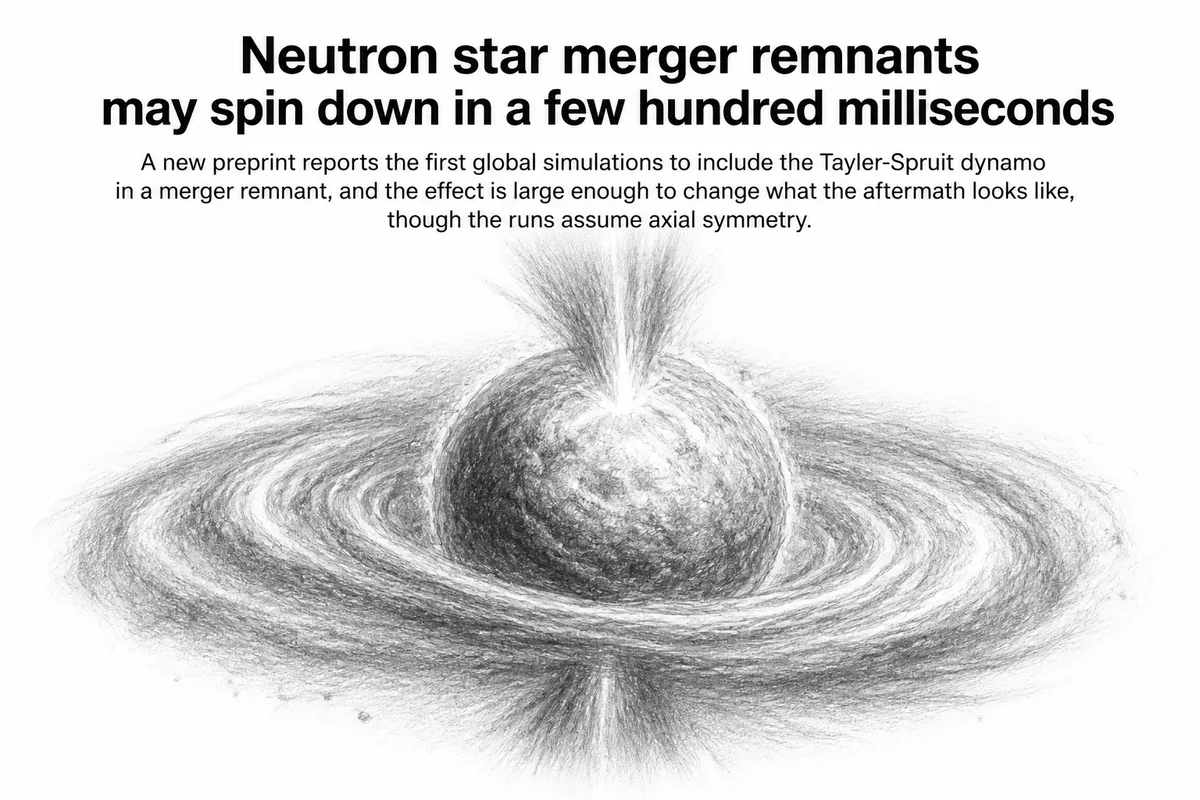
When two neutron stars collide, what survives the first instant is not a clean object. It is a lopsided, wildly spinning ball of nuclear matter, hotter than anything else in the universe, wrapped in a disk of debris and shedding neutrinos. Whether it holds itself up for a second, a minute, or forever depends on a detail that simulations have mostly left out: how fast the remnant sheds its spin.
Harry Ho-Yin Ng and Elias R. Most, writing in a preprint posted to arXiv on 30 July 2026, argue that one particular magnetic process can do that job on a timescale of a few hundred milliseconds. That is fast. It is roughly the window in which the remnant decides whether to collapse into a black hole, and it overlaps with the moment when the disk around it is throwing off the material that later glows as a kilonova.
The process is called the Tayler-Spruit dynamo, and the reason it matters here is a question of geography inside the remnant. Different parts of the object rotate at different rates, and the way that rate changes with distance from the axis determines which instabilities can grow. In the outer regions of the remnant and in the disk, rotation slows outward, which is exactly the condition the magnetorotational instability needs to amplify magnetic fields and drag angular momentum outward. That mechanism is well studied. But the core is different. There, rotation speeds up outward, and the matter is stably stratified, meaning buoyancy resists vertical mixing. The magnetorotational instability has little to work with. The Tayler-Spruit dynamo, which feeds on the instability of a twisted magnetic field rather than on the shear profile alone, does not have the same restriction.
A dynamo too small to simulate
The practical obstacle is scale. The magnetic structures that drive this dynamo are far smaller than anything a global simulation of a whole neutron star can resolve, and no realistic increase in computing power fixes that. Ng and Most work around it with a subgrid prescription: a mean-field recipe that stands in for the unresolved small-scale physics and feeds its effect back into the large-scale flow. They then run that prescription inside general-relativistic magnetohydrodynamics simulations that also track neutrino radiation, starting from a realistic merger remnant rather than an idealized starting point. The authors describe these as the first global, long-term simulations of a merger remnant to include the Tayler-Spruit dynamo this way.
What the dynamo does, in their runs, is concentrated. It switches on mainly at high latitudes in the remnant core, near the rotation axis rather than around the equator. The magnetic stresses it produces then move angular momentum around, and the consequences cascade outward. The core's rotation profile flattens substantially, meaning the sharp differences in spin rate between one layer and the next smooth out. Mass and angular momentum move from the outer remnant into the surrounding disk.
That transfer is where the observational stakes appear. The disk in these simulations ends up more massive, more extended, and more strongly magnetized than it would be otherwise. It also ends up with a lower electron fraction, which is the astrophysicist's shorthand for how many protons there are per nucleon: a low value means the material is dominated by neutrons. Neutron-rich matter is the raw ingredient for building heavy elements, and the simulations produce substantially more neutron-rich ejecta as a result.
Why it matters
Mergers of neutron stars are one of the few places astronomers can watch the heaviest elements being assembled, and the composition of what gets flung out determines both which elements form and what the resulting light looks like as it fades. If a mechanism that current simulations omit shifts that composition toward the neutron-rich end, then predictions calibrated without it are working from an incomplete picture.
The spin-down timescale carries its own weight. A remnant that sheds angular momentum in a few hundred milliseconds is a remnant with a different chance of surviving as a neutron star instead of collapsing, and that distinction shapes everything an observer might detect afterward: the gravitational-wave signal, the radio and X-ray emission, the kilonova. The authors put it as a qualitative change, not a small correction, to the rotational evolution, collapse prospects, disk formation, and multi-messenger signatures of long-lived remnants.
Two cautions are worth keeping in view. This is a preprint, not yet through peer review. And the simulations are axisymmetric, meaning they impose symmetry around the rotation axis and cannot capture structures that break it. Both the dynamo itself and the disk it builds are represented within those limits, with the small-scale physics entering through a prescription rather than being resolved directly. What the work establishes is that the effect is too large to keep ignoring, not yet exactly how large it is.