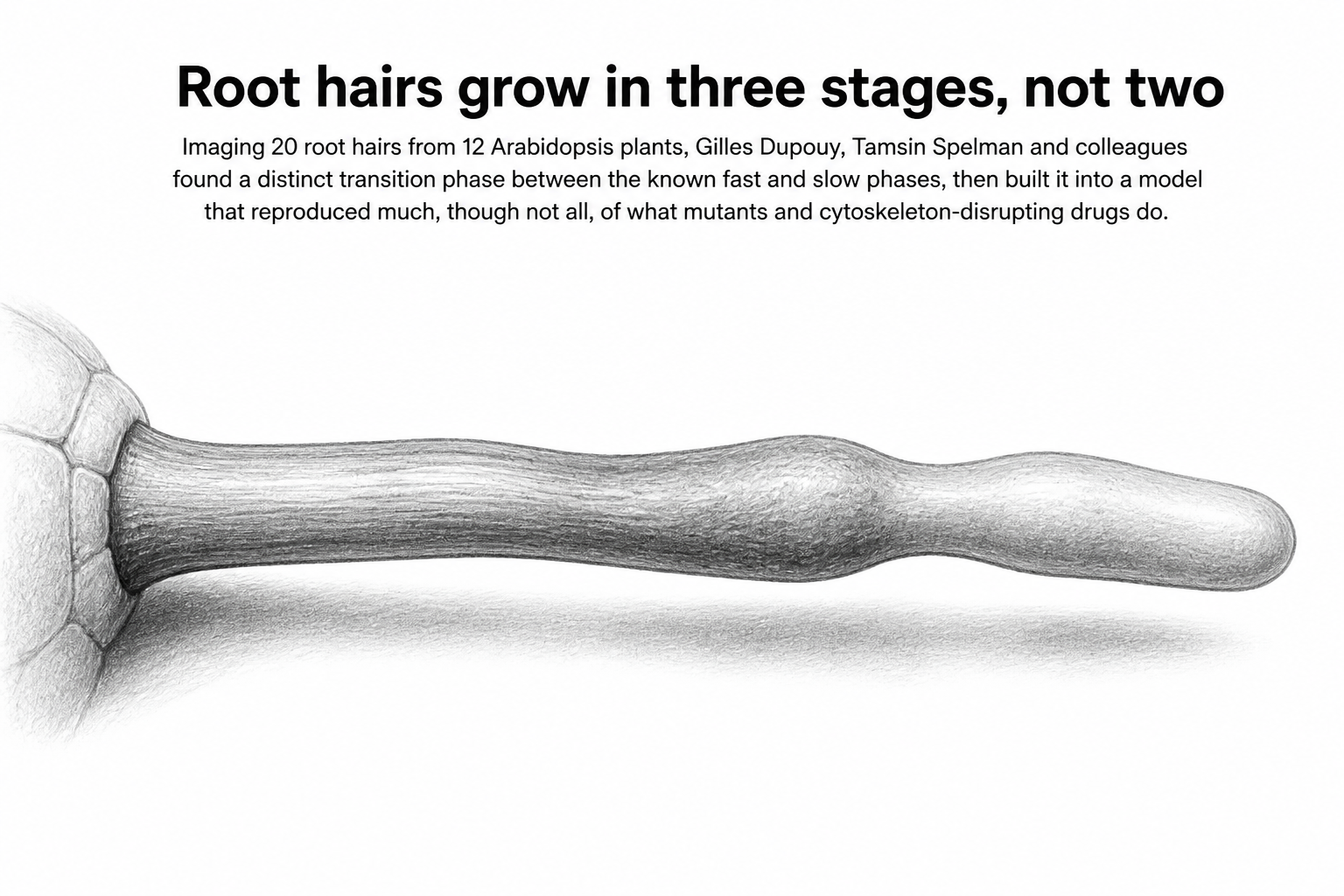
Inside a microfluidic chamber under a confocal microscope, an Arabidopsis root hair pushes its tip forward at roughly one micrometer per minute. Its nucleus trails behind, at a distance the cell keeps under tight control. Then the pace changes. Within an hour of the fast phase ending, the tip has slowed to about half a micrometer per minute, and after roughly two more hours it stops for good.
Fast, then slow. That two-speed description is how root hair growth has usually been taught. New imaging work by Gilles Dupouy, Tamsin Spelman and colleagues, described in a commentary by Jan Wilhelm Schoeller in The Plant Cell, inserts a third act between them.
The team filmed living root hairs of Arabidopsis thaliana, the small mustard plant that serves as the workhorse of plant genetics, growing inside microfluidic devices that hold a root steady while liquid flows past it. They measured how fast each tip advanced over time, then fit those measurements with a piecewise linear model, a statistical fit that looks for straight segments joined at breakpoints. Across 20 root hairs from 12 individual plants, three segments came out where two were expected. The middle one is the transition stage.
Something specific happens during that middle stretch. The nucleus moves closer to the tip. The brightest band of labelled actin, the filament network that doubles as a delivery track for vesicles carrying cell wall material, shifts forward along with it by about 20 micrometers. Microtubules, the stiffer filaments that hold the nucleus at a set distance from the tip, run the opposite way: their signal peaks behind the nucleus at the end of the fast stage and then falls off considerably until growth arrest. The tidy fringe of microtubules that sits at the tip during fast growth comes apart during the transition. Schoeller reads that disassembly as probably clearing the route for the advancing nucleus.
Translating this into equations meant combining things that had stayed in separate models. Building on a 2006 mechanical model of tip growth by Jean Dumais and colleagues, the authors let cell wall extensibility, essentially how readily the wall yields at the growing tip, set the growth rate, and represented actin and microtubules as springs. Some springs pull the nucleus toward the tip, others drag it backward. With those pieces in place, the model reproduced the growth curves and the nuclear movements the team had filmed.
It also captures what comes after. Late in the slow-growing stage the nucleus stops merely moving and starts changing shape, its aspect ratio climbing under forces from the nucleoskeleton, the filament scaffold inside the nucleus itself. Elongation peaks as the hair enters maturity. Once the microtubules are gone, the nucleus is fully disconnected from the tip, and backward pull from actin draws it away again.
A model that admits what it misses
The honest test of a model like this is whether it predicts results it was not built from. The authors compared their simulations against growth data from mutant plants and from plants treated with drugs that disrupt cytoskeletal dynamics. The model captured many of the observed effects. Not all of them. Schoeller's read is that the framework is robust for simulating root hair tip growth, and that folding in more cytoskeletal complexity should improve its accuracy.
Two quantities are conspicuously absent, and the authors say so. Nobody can yet track turgor pressure, the internal water pressure that pushes the tip outward, or cell wall stiffness continuously through a root hair's life. Schoeller likens root hairs to narrow side tunnels branching off the main shafts of a root system, with the wall acting as the timber that keeps them from collapsing. Measuring the reinforcements while the tunnel is being dug is the missing piece. He points to molecular rotor probes, dyes whose fluorescence responds to their mechanical surroundings, reported by Besten and colleagues in 2025, as one route worth trying.
Why it matters
Root hairs are where a plant meets the soil. They extend the surface available for taking up water and nutrients, and their length is under enough agricultural pressure that separate work in wheat has tied a single gene to how long they grow and how well the plant feeds itself. Understanding what sets the moment a root hair stops growing is not a small question for a plant that has to find water in a dry season.
What this work offers is less a discovery than a working description. Growth rate, filament organization, and where the nucleus sits have mostly been studied and modeled apart from one another. Here they move together in a single framework, and the framework makes claims specific enough to be wrong in interesting ways, as the mutant comparisons already showed.
The usual limits apply. This is one species, 20 root hairs, 12 plants, all grown in a microfluidic chamber rather than soil. The transition stage is a real feature of the measured kinetics, but whether it turns out to be a general rule of tip growth, in pollen tubes and fungal hyphae as well as root hairs, is a question the next set of experiments will have to answer.