Twenty-eight species, each with its own narrow window of warmth and moisture in which a seed will actually sprout. That is the raw material behind a new preprint from researchers at Western Sydney University and collaborating institutions, who set out to map those windows for native plants of the Sydney region and then ask what a hotter, drier future does to them.
The team worked with species drawn from three vegetation types in a temperate bioregion: grassy woodland, dry forest, and wet forest. Within that set they sampled four functional types, meaning broad categories of plant form and life strategy: trees, shrubs, grasses, and forbs (soft-stemmed flowering plants that are not grasses). For each species they characterised two things. One was the thermal niche, the range and optimum of temperatures at which seeds germinate. The other was the hydric niche, the range of water availability that permits germination. Seeds are famously particular about both. A seed sitting in soil is not making a decision so much as running a chemical threshold test, and if the temperature or the moisture falls outside its tolerances, nothing happens.
What the researchers found first was variety. Thermal and hydric niches differed widely from species to species, which is a useful reminder that "native vegetation" is not a single thing with a single climate tolerance. But the variation was not random. Three factors predicted a species' optimal germination temperature: its functional type, its climate of origin, and its seed traits. Shrubs germinated best at cooler temperatures than other functional types. So did species originating from cooler parts of the landscape, which is intuitive enough. So did species with large seeds, which is less obvious, and which suggests seed size carries information about a plant's germination strategy beyond simple resource storage.
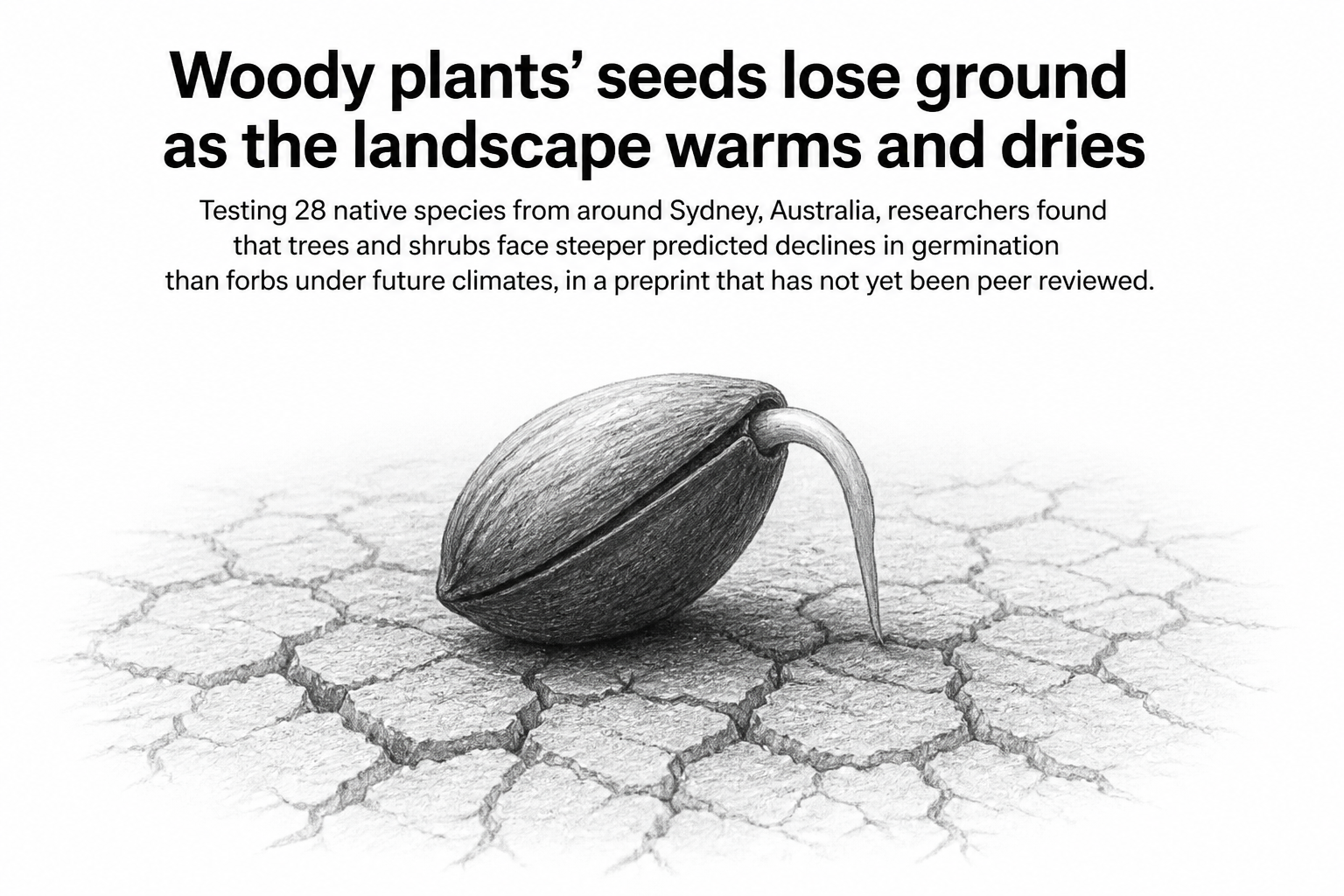
Having pinned down what each species needs, the team projected those requirements onto the landscape, across seasons and into the future under both a high and a low emissions scenario. This is where the picture gets uneven. Germination potential, the modelled likelihood that conditions suit a given species at a given place and time, showed strong seasonal patterns that were specific to individual species. Under future climate shifts, functional types diverged: the authors report that germination of woody species declined more than that of forbs.
The map matters as much as the species
The geography told a parallel story. Future germination potential could be predicted from historical climate conditions, and the localities already at the warm, dry end of the range were the ones facing the steepest declines. Places that are currently marginal for germination become more marginal. Places with more thermal and moisture headroom hold up better. Two patches of bush a modest distance apart, in other words, may be on quite different trajectories, and the difference is legible in climate records that already exist.
Some care is warranted in reading this. The work is a preprint on bioRxiv, posted in July 2026 and not yet through peer review. The germination niches come from controlled measurements of seed responses to temperature and water; the landscape projections are models built on those measurements, not observations of seedlings failing in the field. Germination is also only one step in a plant's life. A seed that sprouts still has to survive as a seedling, and the paper is explicit that it is characterising germination potential rather than recruitment outcomes end to end. The 28 species, while spanning four functional types and three vegetation types, represent one temperate bioregion around a single Australian city.
Why it matters
A forest can look entirely healthy while quietly failing to replace itself. Mature trees and shrubs are long-lived and buffered against bad years, so the failure shows up first in the part of the life cycle nobody sees, and it shows up decades before the canopy changes. If woody species really are losing germination potential faster than herbaceous ones, the composition of these communities may drift toward the plants that can still recruit, without any obvious signal of loss along the way.
The practical value here is that the findings point somewhere specific. Because the vulnerable places can be identified from historical climate data, conservation planners have a way to triage: the warmest, driest parts of a landscape are where woody recruitment is likeliest to fail first. And because the germination niches are measured per species, restoration practitioners get two levers they can actually pull. They can choose species whose thermal and hydric requirements match where a site is heading rather than where it has been. And they can time sowing to the seasonal window when conditions still fall inside a species' niche, which the seasonal modelling suggests varies considerably from one species to the next.
None of that reverses the underlying trend. It does make the difference between planting into a shrinking window and planting into the one that remains.