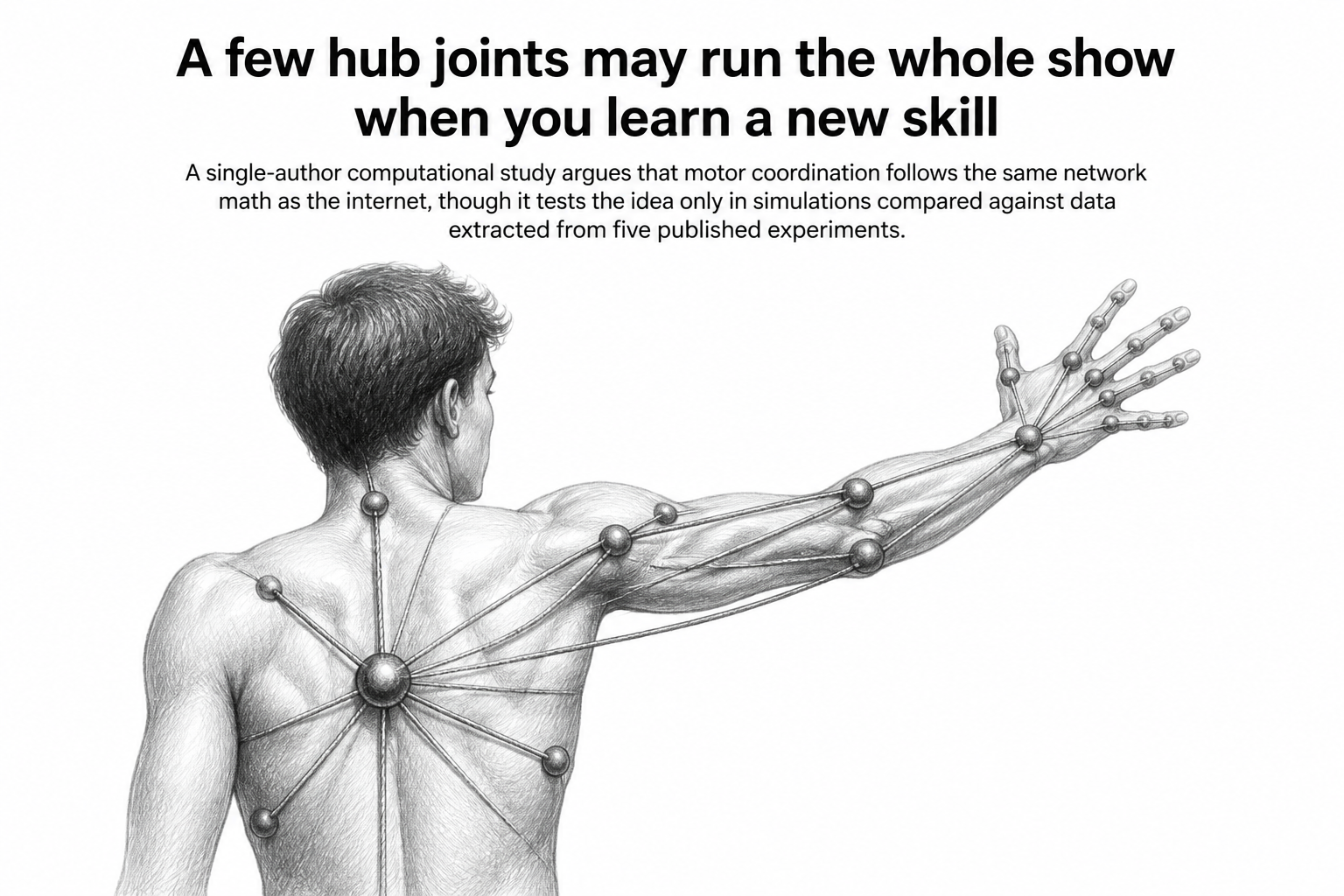
Your body has roughly 600 skeletal muscles and about 100 mechanical joints to steer. Count position and velocity for each and you get a 200-dimensional problem that the nervous system solves every time you reach for a cup. It should be overwhelming. It isn't, and the reason has been one of motor control's oldest open questions.
The Russian physiologist Nikolai Bernstein framed it in the 1960s: the brain doesn't steer each joint separately. It bundles them into functional groups, called coordinative structures or muscle synergies, so that pulling one string moves several. Researchers have measured these bundles for decades. Across a wide range of tasks, just four to eight synergies account for most of the variation in muscle activation. What nobody had was a mechanism. Why bundles at all, and why are some elements clearly in charge of others?
Chulwook Park, a researcher at Seoul National University with affiliations at IIASA in Austria and OIST in Japan, proposes an answer borrowed from network science. Treat each degree of freedom as a node in a network, he argues, and coordination looks like a scale-free network: the lopsided architecture found in metabolic pathways, protein interactions, brain connectivity, and the internet, where a handful of richly connected hubs sit above a crowd of sparsely connected nodes.
To test it, Park built three networks of 100 nodes each with the same average number of connections per node, about six, so the only difference was how those connections were distributed. One was random. One was a small-world network, heavily clustered with a few shortcuts. The third was scale-free, grown by the rule that new nodes preferentially attach to already-popular ones. Then he ran the same battery of simulations on all three, a hundred independent versions of each.
The scale-free network won on every measure Park had defined in advance. Its degree heterogeneity, a statistic that captures how unevenly connections are spread, came out at 9.67 against 6.84 for random and 6.09 for small-world. When he sparked an activation cascade at a hub, it spread 3.6 times faster than one started at the periphery; the random network managed 2.25 and the small-world only 1.46. Only the scale-free version cleared a ratio of 2 in all 100 runs.
Two further results carry the argument. Scale-free networks were robust yet fragile: knocking out random nodes barely dented them, but removing the top hubs shattered them, fragmenting the network 2.9 times more severely than random removal did. That mirrors a familiar clinical asymmetry, where a finger injury changes precision while a shoulder or a stroke can require rebuilding a movement from scratch. And when Park let the networks learn, strengthening connections between elements that fired together, the scale-free version reached half-coordination in 56 practice steps against 84 for random and 262 for small-world. Hub-to-hub connections grew about twelve times stronger than periphery-to-periphery ones. In the other two topologies that hierarchy never formed at all.
The learning curve that came out has a shape athletes will recognize: a long flat plateau, then a sudden breakthrough, then slow refinement. In network terms, that's a percolation transition, the moment scattered clusters of connectivity abruptly fuse into one spanning whole. Just before it, the model predicts a spike in trial-to-trial variability, performance getting messier right before it gets better.
Why it matters
That prediction is where the paper reaches outside its own simulations. Park compared his curves against numbers extracted from five previously published experiments, including a roller ball learning study by Liu, Mayer-Kress and Newell and a classic bimanual coordination experiment by Kelso, Scholz and Schöner. Both show the variability spike at the transition, on timescales that differ by orders of magnitude.
It is worth being clear about what this is and isn't. Park ran no experiments. The validation is a comparison against data pulled from published figures, not a fresh test, and he says plainly that no standard method yet exists for extracting a coordination network from movement data at all. Different techniques would draw different networks from the same recordings. Until that is settled, he writes, his numbers should be read as ratio predictions rather than absolute values.
What the paper offers instead is a target. It lists eleven quantitative predictions and, unusually, five specific results that would sink it: symmetric cascades, coordination networks that turn out not to be scale-free, learning curves that only ever improve, transfer that ignores hub overlap, uniform connection strengthening. Each is tied to one mechanism, so a failure would point at the broken part rather than the whole idea. The most testable prediction needs only a perturbation experiment on a well-studied multi-joint movement with the hubs identified beforehand.
If it holds, coaching and rehabilitation get a rationale for something practitioners already half-suspect: train the proximal hubs first, and read a plateau as the network quietly accumulating connections below threshold rather than as a learner stuck. The code and validation data are openly archived. Now someone has to go collect the movements.