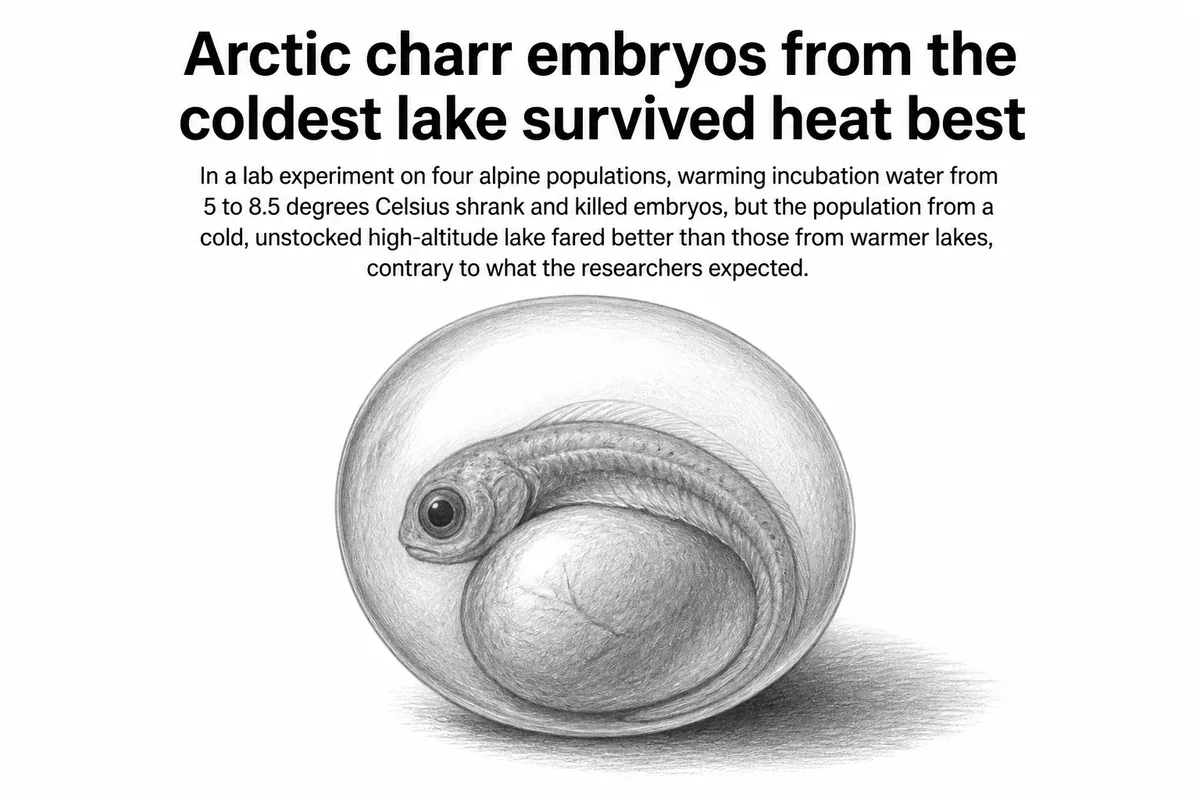
Arctic charr lay their eggs in cold water and leave them there for months. The embryos develop slowly through winter, drawing on a yolk sac that has to last until the young fish can feed themselves. A few degrees of extra warmth changes everything about that schedule.
Herve Rogissart and colleagues at INRAE, the University of Savoie Mont Blanc and partner institutions wanted to know whether some charr populations are better equipped for that warmth than others. They collected eggs from four populations living in lakes with contrasting temperatures, then raised the embryos side by side under identical conditions: one batch at 5 degrees Celsius, close to optimal for larval development, and one at 8.5 degrees, warmer but within the range these fish could realistically face. This is what biologists call a common garden experiment. Because every embryo experiences the same tank, the same water and the same handling, differences that persist between populations are more likely to be inherited than to be leftovers from the parents' home lake.
The warmer water was harder on the fish across the board. The team reports lower survival, smaller body size at hatching, and earlier hatching. That last one sounds neutral but is not: development runs on accumulated warmth, so heat pushes embryos out of the egg sooner, at a smaller size, with less time to build a body before they have to start finding food.
What interested the authors more was that the four populations did not respond in the same way. Their thermal reaction norms, meaning the shape of the line connecting a population's trait value at 5 degrees to its value at 8.5 degrees, differed from one another. To test whether those differences reflect real adaptation rather than the random drift that separates any two isolated populations over time, the team used a Qst-Fst comparison. Fst measures how genetically different the populations are at neutral markers, the background rate of divergence you would expect from isolation alone. Qst measures how different they are in the traits themselves. When trait divergence outruns the neutral background, natural selection is the likelier explanation. In four traits, survival, incubation duration, body length and yolk sac volume, the comparison pointed toward adaptive divergence.
The population that broke the pattern
The obvious prediction is that charr from warmer lakes should handle warmth better, having had more practice. That is not what the researchers found. Populations from warmer environments did not consistently do better under elevated temperature.
Instead the standout was a population from a cold, high-altitude lake with no management history: no stocking, no repopulation program, no introduced fish. Under heat stress those embryos survived at higher rates than the others, and they held smaller yolk reserves for a given body size. The authors read that second detail as more efficient use of the yolk, converting stored energy into body tissue rather than sitting on it.
Why would the coldest, least-tended population be the toughest? The authors' explanation is that a population's history matters as much as its thermometer. Three of the four have been shaped by human hands, through introductions of fish from elsewhere, through crashes and rebounds in numbers, and through decades of repopulation stocking. Each of those can scramble the genetic material selection has to work with. Stocking in particular can keep a population going while quietly overwriting local adaptation with genes from hatchery fish or other lakes. The unmanaged population had none of that interference, and it also has the smallest cushion: high-altitude lakes are the last cold refuges, and a fish there has nowhere colder to go.
That reading is the authors' interpretation, not something the experiment tested directly. The design compares four populations, which is enough to show they differ but thin for separating altitude from management from origin, since those things travel together in this sample. The work is also a preprint, posted to bioRxiv and not yet through peer review.
Why it matters
Arctic charr are stenotherms, tolerating only a narrow band of temperatures, and in the Alps they live in lakes that are warming around them with no cold water upstream to retreat to. Whether these populations persist depends partly on how much adaptive potential their most vulnerable life stage still holds.
The useful and slightly uncomfortable finding here is that you cannot read that potential off a map. A manager looking at which alpine charr populations are best prepared for a warmer century might reasonably start with the ones already living in warm lakes. This experiment suggests that guess can be wrong, and that the fish carrying the most useful variation may be in the coldest, least-visited lakes, the ones nobody has been topping up with hatchery stock.
That has a practical edge for anyone deciding where to put conservation effort. Stocking keeps fish in a lake. It does not obviously keep a population's capacity to adapt intact, and it may work against it. Testing that properly would take more populations, and reaction norms measured across more than two temperatures. For now the four charr populations in this study make the case that history is written into how a fish handles heat.