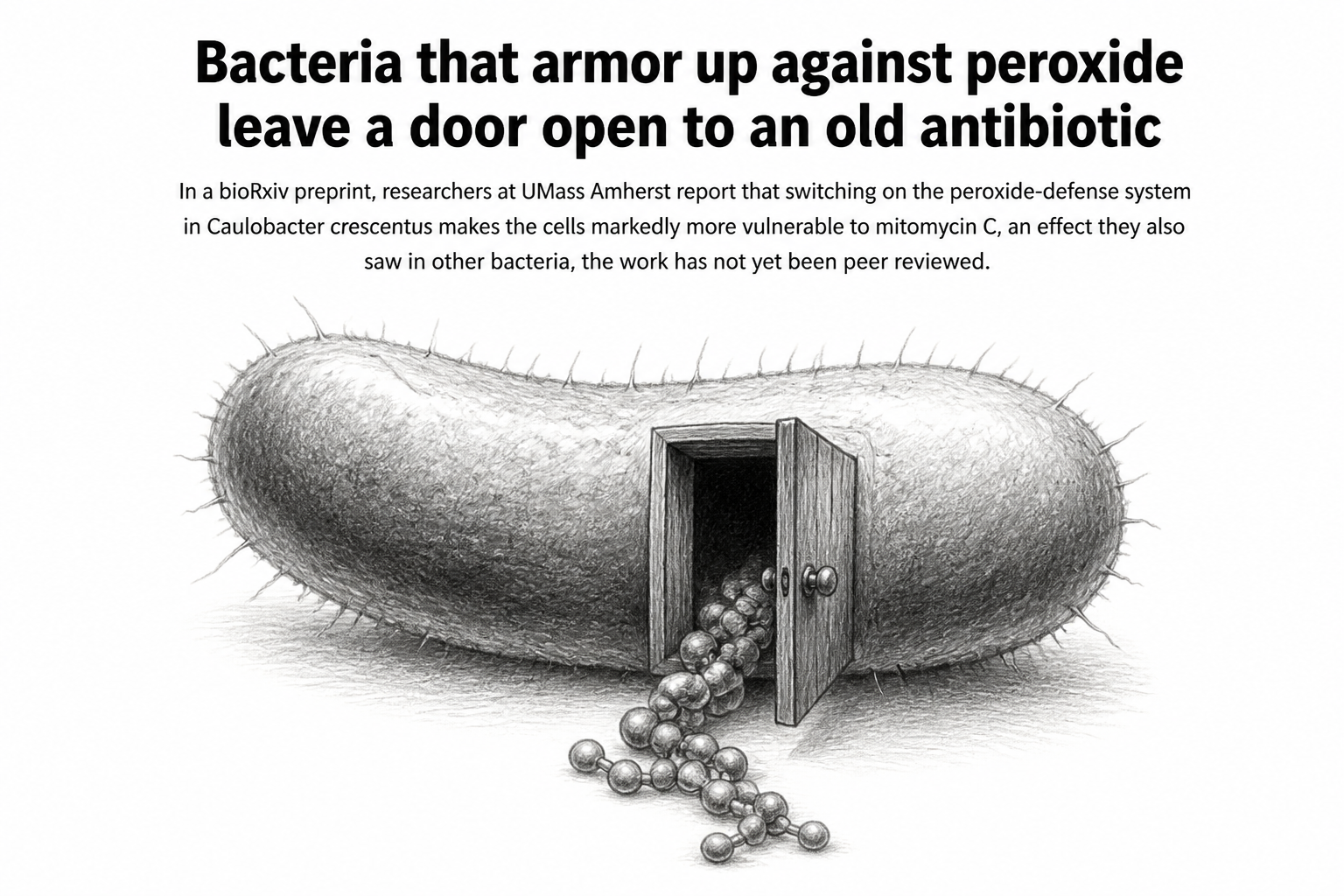
Hydrogen peroxide is a weapon, and bacteria know it. Immune cells make it, neighboring microbes make it, and a cell caught without defenses gets its DNA and proteins chewed apart. So bacteria keep a sensor on hand. In Caulobacter crescentus, a freshwater bacterium that biologists have studied for decades because of its tidy, predictable life cycle, that sensor is a protein called OxyR: a transcription factor, meaning it switches genes on. When peroxide shows up, OxyR flips on the genes that break it down. Simple, protective, and by every obvious measure a good deal for the cell.
Kubra Yigit, Anna Chapman, and Peter Chien at the University of Massachusetts Amherst report that the deal comes with a bill attached. In a preprint posted to bioRxiv on July 30, 2026, they describe what happens when OxyR is left switched on: the cells shrug off peroxide, exactly as expected, and then fall to a drug they would otherwise have survived.
Two genes, two very different consequences
The team worked with a version of OxyR locked into its active state, a genetic trick that lets them study a stress response without the stress. Those cells turned up two things at once. One was KatG, a catalase-peroxidase, an enzyme that takes hydrogen peroxide apart. That is the protection, and it worked: the authors attribute the cells' peroxide resistance to KatG specifically.
The other was AhpCF, a reductase. Reductases hand out electrons. In the ordinary run of a cell's chemistry that is useful housekeeping, and against peroxide it is another line of defense. But electrons are not selective about what they land on, and mitomycin C is a molecule that waits for exactly that.
Mitomycin C is what chemists call a prodrug: it arrives inert and has to be chemically activated before it does anything. The activation step is a reduction, the addition of electrons. Once activated, it becomes a genotoxin, a compound that damages DNA by welding the two strands of the double helix together so the cell can no longer copy or read them. A cell full of reductase is a cell full of the thing that arms the drug. The authors' finding is that the same OxyR switch that shields Caulobacter from peroxide loads the gun that mitomycin C is holding.
Two details make this more than a quirk of one engineered strain. First, the authors report that the vulnerability does not require a mutant at all: a brief exposure to oxidative stress is enough to induce it. Real bacteria in real environments meet peroxide constantly, which means this is a state cells can enter and leave on their own. Second, the effect is not confined to Caulobacter. The team writes that it extends to bacteria beyond it, though the abstract available here does not name which species or say how far the pattern generalizes.
Why it matters
Antibiotic resistance is usually told as a story of accumulation: bacteria pick up defenses, and each defense is a straightforward win. This result argues that the ledger is more complicated. Turning on one protective program can, as a side effect, deepen a weakness somewhere else. Researchers call this collateral sensitivity, and it is interesting precisely because it is predictable. If you know which defense a population has switched on, you may know which drug it cannot handle.
Mitomycin C is not a hypothetical compound. It has been used against tumors for a long time, and its mechanism, reductive activation followed by DNA crosslinking, is the same in a bacterium as anywhere else. A stress state that reliably raises reductase levels is, in principle, a state that makes cells easier to kill with a prodrug of that type. The authors frame the result as a hidden cost of antioxidant signaling rather than a treatment strategy, and that restraint is worth keeping. Nothing here was tested in an infection, in an animal, or in a person.
The more immediate value is conceptual. It shows that a stress response cannot be scored on its own terms, only against the full range of things a cell might meet next. Caulobacter defending itself against peroxide is not making a mistake. It is making a trade, and the cost only appears when a particular molecule walks in.
One caveat deserves its own sentence. This is a preprint, meaning it has been posted publicly but has not gone through peer review, and the material available is the abstract rather than the full experimental record. The dose-response numbers, the identity of the other bacteria tested, and how large the sensitization effect is are all still on the other side of that door.