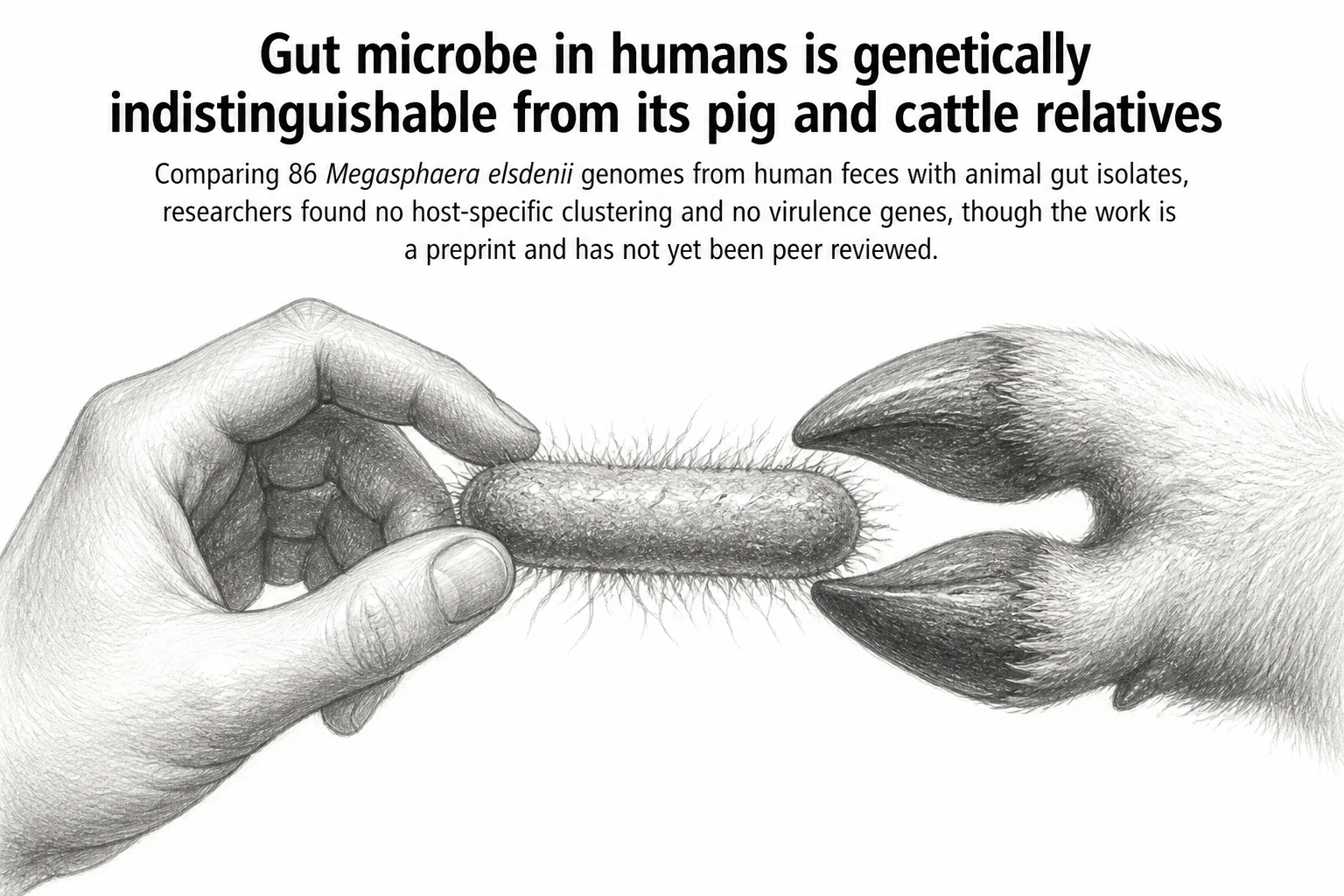
A cow's rumen and a human colon are not much alike. One is a churning fermentation vat the size of a bathtub, fed on grass; the other is a narrow tube at the end of a very different digestive tract, fed on whatever we ate. Yet a bacterium living in both places appears to be, genetically speaking, the same bacterium doing the same job.
That is the picture that emerges from a new preprint by Dina Sabirova, Bayazit Yunusbayev and colleagues at institutions in Saint Petersburg and Moscow, posted to bioRxiv on July 30, 2026. The team assembled 86 genomes of Megasphaera elsdenii recovered from human feces, used as a stand-in for the human gut, and compared them against isolates from animal guts. As a further point of contrast, they added genomes of the same species taken from a completely different part of the body: the vaginal niche.
M. elsdenii is a familiar name in animal science. In cattle it is one of the more prominent consumers of lactate, the acid that builds up in the rumen when livestock are switched onto grain-heavy diets. Mop up the lactate and the rumen stays less acidic. In people, the same species turns up in the feces of healthy donors, but it turns up more often in patients with a range of inflammatory conditions. That pattern raises an obvious and uncomfortable question. Is the human version a different beast, perhaps a troublemaker, or is it the same lactate eater that happens to bloom when conditions suit it?
What the genomes showed
The phylogenetic tree gave a blunt answer. Human gut genomes did not form their own branch. Instead they fell into a single genetically homogeneous group alongside the animal gut isolates, intermingled with them, with no clustering by host that the authors could detect. Human samples shared most of their genes and biochemical pathways with isolates from swine and cattle, despite the substantial anatomical differences between a pig's gut, a cow's, and ours.
The team then pushed harder. Unsupervised comparison can miss small signals, so they labeled the genomes by host and ran a supervised analysis, essentially asking a method that already knows the answer to find whatever features distinguish human from animal. It found only minor differences in pathway content. If there is a human-specific version of this microbe, it is not showing up in the gene inventory.
The strongest part of the argument may be the metabolic modeling. Rather than counting genes, the researchers built genome-scale metabolic models, computational reconstructions that take a genome's full enzyme complement and simulate what the cell can and cannot live on. Those models suggest human and animal gut strains share identical carbon and energy source requirements. The requirement for lactate and acetate held up across every sample the team examined, regardless of which host it came from or whether it came from the gut or the vagina. Different bodies, different neighborhoods, same appetite.
Finally, the authors searched for virulence genes, the genetic equipment bacteria use to damage a host, and found none.
Why it matters
The association between M. elsdenii and inflammatory conditions in people is real enough to have been noticed repeatedly. What has been missing is an explanation. One reading is that the microbe is an agent of the problem. Another is that it is a passenger, thriving because inflamed or disturbed guts produce more of what it eats. This analysis does not settle the question, but it removes a supporting leg from the first reading: the genomes carry no virulence genes, and the human strains are not a distinct lineage with distinct capabilities. The authors put it carefully. Lactate utilization, they write, remains a plausible explanation for why M. elsdenii accumulates in different niches.
There is a practical angle too. M. elsdenii is already fed to cattle as a direct-fed microbial to manage rumen acidosis, so the question of whether the animal and human versions are the same organism is not purely academic. This work suggests they are closely related and metabolically alike, which is reassuring as far as it goes.
The limits deserve naming. This is a preprint, not yet peer reviewed. Fecal genomes are a proxy for the gut, not a direct sample of it, and the human material comes from stool rather than from the colon itself. Genomes describe what a microbe could do, and metabolic models describe what it plausibly would do given the right inputs; neither is a measurement of what these bacteria are actually doing inside a living person. An organism with no virulence genes in its genome can still be present at the wrong time in the wrong quantity.
Still, the shape of the result is worth sitting with. A bacterium that we tend to sort into categories, livestock microbe here, human commensal there, apparently does not recognize the distinction. It follows the lactate.