On the first morning of the workshop, before any slide deck appeared, the organisers planted a tree in the grounds of the All India Institute of Hygiene and Public Health in Kolkata. They named it Chaya, the Hindi word for shade. It was a ceremonial gesture, but a pointed one: over the next two days, shade, water and rest would come up repeatedly as the most practical protections available to Indian workers facing rising heat.
The meeting, held on 10 and 11 October 2025, was convened by AIIHPH under the Ministry of Health and Family Welfare, with the National Centre for Disease Control and the National Programme on Climate Change and Human Health. Its proceedings have now been published in the Indian Journal of Occupational and Environmental Medicine. This is a record of what a room of experts agreed on, not a study with results. Nothing here was measured or tested; the value lies in what India's occupational health establishment says it does not yet know, and what it intends to build.
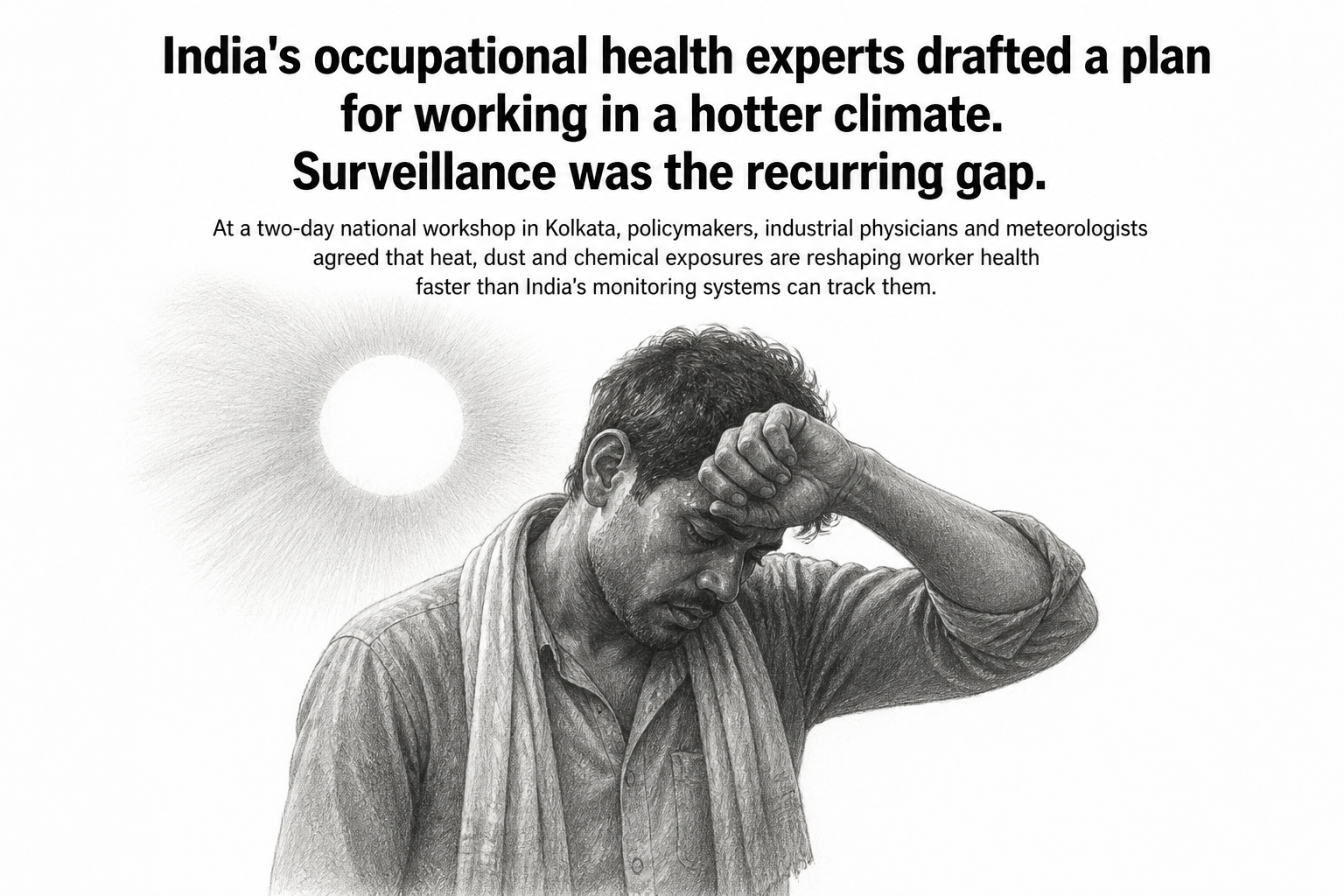
Discussions ran across five themes: extreme heat, air pollution, chemical exposures, technology, and psychosocial wellbeing. A single problem cut across all five. Debashis Dutt, dean at AIIHPH, presented field data from industrial sectors and reported that awareness and reporting mechanisms for heat-related disorders remain limited. The workshop's own summary table is blunter: surveillance of heat-related illness "remains poor, especially in unorganized sectors", and fragmented health and environment datasets impede management. Workers get sick from heat, and much of it is never recorded anywhere.
That matters most for the majority of India's workforce. Monalisha Sahu, who heads AIIHPH's occupational health department, noted that unorganised sector workers make up most of the country's labour force yet sit outside formal occupational health frameworks entirely. Her proposal was to connect the e-Shram portal, the government's registry of unorganised workers, to health and climate vulnerability data, so that interventions could be aimed at specific groups of informal and migrant workers rather than at the workforce in general.
Several speakers pushed for the same fix from different angles: link what the weather services already know to what happens on a shop floor. H. R. Biswas of the India Meteorological Department's Kolkata regional centre described how heatwave alerts could be used by industries to schedule shifts and plan hydration. The recommendations go further, calling for IMD data feeds to be used for localised alerts and for heat-related illness surveillance to be tied to Wet Bulb Globe Temperature readings, a measure that combines heat, humidity, sun and air movement into a single number closer to what a body actually experiences. One discussion point asks for a shift away from temperature-based warnings toward alerts framed around worker health specifically.
The chemical session raised a wrinkle that is easy to overlook. Chemical safety limits assume stable conditions, and the chairs pointed out that heat, humidity and extreme weather can change how chemicals behave: their stability, how dust travels, how much a worker absorbs. The summary notes that heat increases both absorption and toxicity. Sanjib Kumar Jana of IVL Dhunseri Petrochem described how temperature and humidity swings alter chemical volatility and exposure patterns in petrochemical plants, and argued for standard operating procedures that adapt to weather rather than ignoring it. Participants asked for research on climate effects on toxicity, mandatory biomonitoring, and antidotes stocked near factories and farm fields.
On air pollution, the framing was double exposure: city air on the commute, industrial air at work, and for many women a third layer of indoor cooking smoke at home. Deepanjan Majumdar of NEERI made the case for low-cost air quality sensors cheap enough to deploy in small firms and informal workplaces. Sandeep Thacker of UNICEF spoke about waste recyclers, street vendors and construction labourers, whose exposures rarely appear in any dataset.
The technology session was notably unromantic about its own tools. Arkaprabha Sau of the Regional Labour Institute showed IoT devices that track ambient conditions alongside heart rate and core body temperature to trigger heat stress alerts. Himank Agrawal of IIT Indore discussed machine learning for predicting hazards, and raised data privacy and transparency as open questions. The chairs, R. P. Bhave and Ashok Puranik, cautioned that these systems should complement human oversight rather than replace it, and that field validation is still missing. The recommendations concede that "data and validation gaps persist in R&D".
Why it matters
Most climate coverage measures damage in degrees and disasters. This workshop treated it as an occupational hazard, which puts it in the same category as noise, dust and machine guards: something an employer is expected to manage.
The practical obstacle the participants identified is not ignorance of the risk but the absence of a record. Without surveillance data, heat illness and pollution exposure never become numbers that support policy, compensation claims, or inspections. Sessions repeatedly returned to the same asks: district-level monitoring units, occupational exposure included in national clean air dashboards, heat indicators folded into existing health reporting.
The stated outcome was consensus on a National Framework for Climate-Resilient Worker Safety and Health, requiring three ministries (health, labour, environment) to work together, and support rather than punishment for small and medium enterprises. Whether that framework arrives, and whether it reaches informal workers who lack an employer to regulate, remains to be seen. The proceedings are a statement of intent, and worth reading as such.