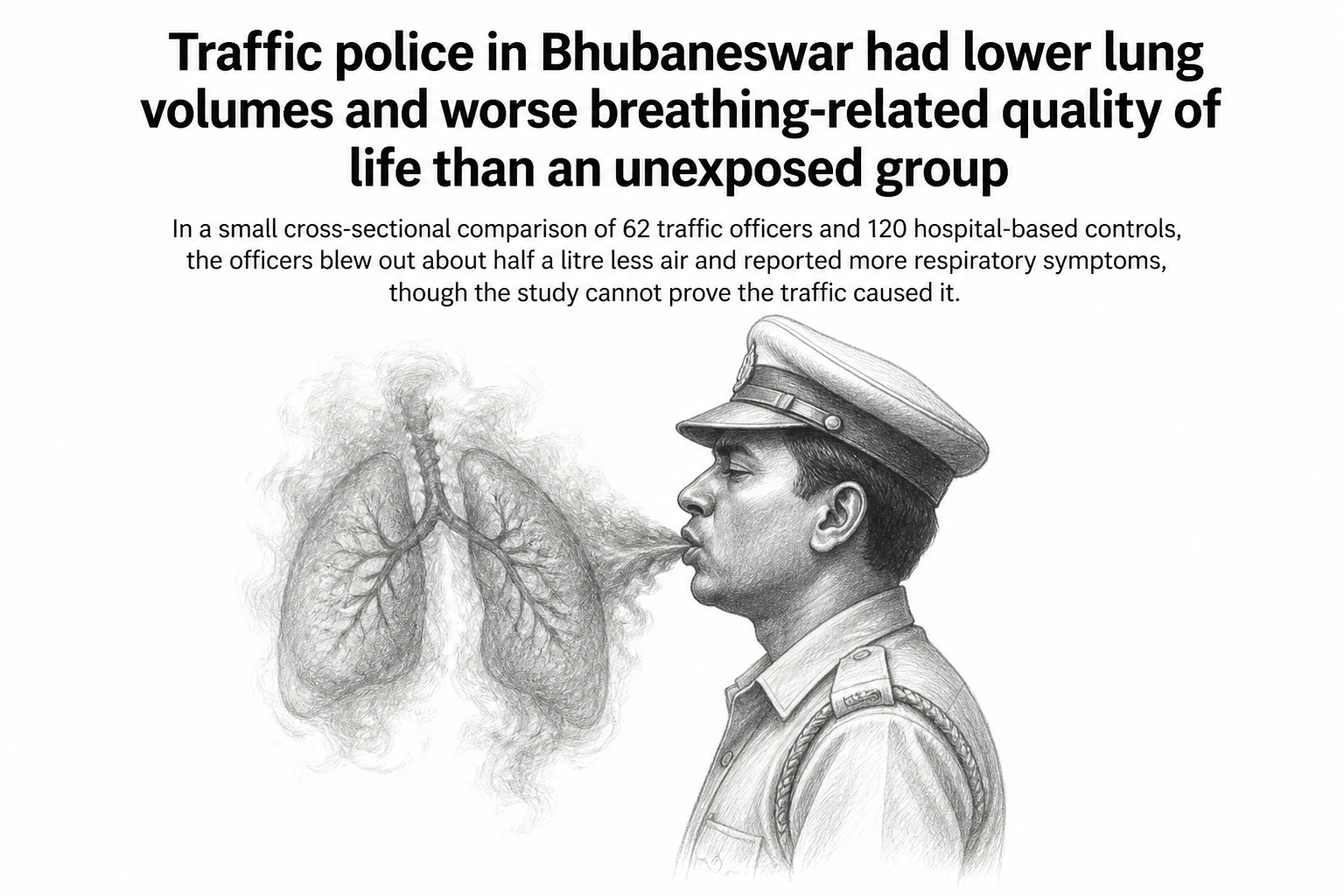
Bhubaneswar's air quality index sits at 142, mostly from vehicle exhaust. The state pollution board's own figure, cited by the study's authors, puts that at 13.2 times the level the World Health Organization considers acceptable. Standing in the middle of it, eight hours a day, six days a week, are the city's traffic police.
A team from the Department of Community Medicine at Kalinga Institute of Medical Sciences set out to measure what that costs. Between October 2023 and January 2024, Ipsita Debata and colleagues recruited 62 traffic officers who had been on active duty for at least a year, and 120 comparison participants drawn from attendants and non-clinical staff at the medical college's teaching hospital, people whose days involve little outdoor air. Everyone was between 18 and 60. Anyone with known asthma, COPD, or tuberculosis was excluded from the start, so this is a comparison of people who considered themselves healthy.
Each participant did two things. They filled out the St George's Respiratory Questionnaire, a validated survey that converts answers about coughing, breathlessness, and the daily activities breathing gets in the way of into a score from 0 (no impairment) to 100 (maximum impairment). Then, between 8 a.m. and noon, they breathed into a handheld digital spirometer: inhale to full capacity, blow out as hard and fast as possible, best of three attempts.
The spirometry gap was the clearest result. Officers averaged 1.94 litres of forced vital capacity, the total volume they could push out after a full breath in, against 2.45 litres in the unexposed group. Forced expiratory volume in one second, the amount moved in that first hard second, was 1.89 litres versus 2.44. Both differences carried a P value below 0.001, meaning they are very unlikely to be chance alone.
What did not differ was the ratio between those two numbers. In both groups, FEV1 divided by FVC sat near 98 to 99 percent. That pattern matters clinically: when airways are narrowed, as in asthma, the ratio drops because air comes out slowly. Here the airways looked open. Both volumes were simply smaller, with FVC falling proportionally more. The authors read this as an early restrictive pattern, lungs moving less air overall rather than moving it through obstructed passages.
On the questionnaire, the symptom score told the strongest story: 15.07 in the officers against 6.71 in the comparison group, more than double. Activity scores (40.00 versus 39.03) and impact scores (3.99 versus 3.63) were much closer together, though both reached statistical significance. Total scores were 16.74 and 14.87. These are not scores that describe sick people. They describe a modest, measurable difference between two groups of people who all thought of themselves as well.
The correlations linking the two measures were weak. Across the whole study population, FVC and FEV1 both correlated negatively with total questionnaire scores (r around -0.27), so lower lung volumes went with worse self-reported breathing. Within the traffic police group alone, only one correlation cleared significance: FEV1 against the symptom score, at r = -0.253 and P = 0.047, close enough to the threshold to warrant caution.
What the study cannot tell you
This is a snapshot, not a film. Everyone was measured once, so nothing here establishes that traffic exposure caused the smaller lung volumes. The authors are candid about the gaps. The groups differed significantly in age (officers averaged 31.5 years, the comparison group 33.9) and in education, despite an attempt at matching. Smokers stayed in both groups because they were a small minority, roughly 5 percent of officers and 8 percent of the comparison group, but smoking still confounds respiratory measurements. And the team never measured the actual pollutants in the air at any officer's post. The exposure in this study is the job itself, not a reading from an instrument.
The sample was also small, 182 people in a single city, and the authors say plainly that a larger one would have given firmer answers.
Why it matters
Occupational health research on traffic police has mostly measured lungs. This team measured lungs and asked people how their breathing felt, and found the two lined up. That combination is what makes the paper useful, and the authors note they found no published work correlating these two particular tools, so the comparison stands on its own for now.
The practical point is about screening. A questionnaire costs nothing beyond the time to answer it, and a handheld spirometer is portable enough for a primary health centre. The authors argue both belong in routine surveillance for people who work in traffic, catching declines while they are still small.
There is a broader reason to pay attention. Bhubaneswar is not a megacity. It is a growing state capital where tourism and IT jobs have pushed more vehicles onto the roads, which is the trajectory of hundreds of cities across South and Southeast Asia. The people directing traffic in them stand where the exhaust is thickest, and they are usually the last to be measured.